


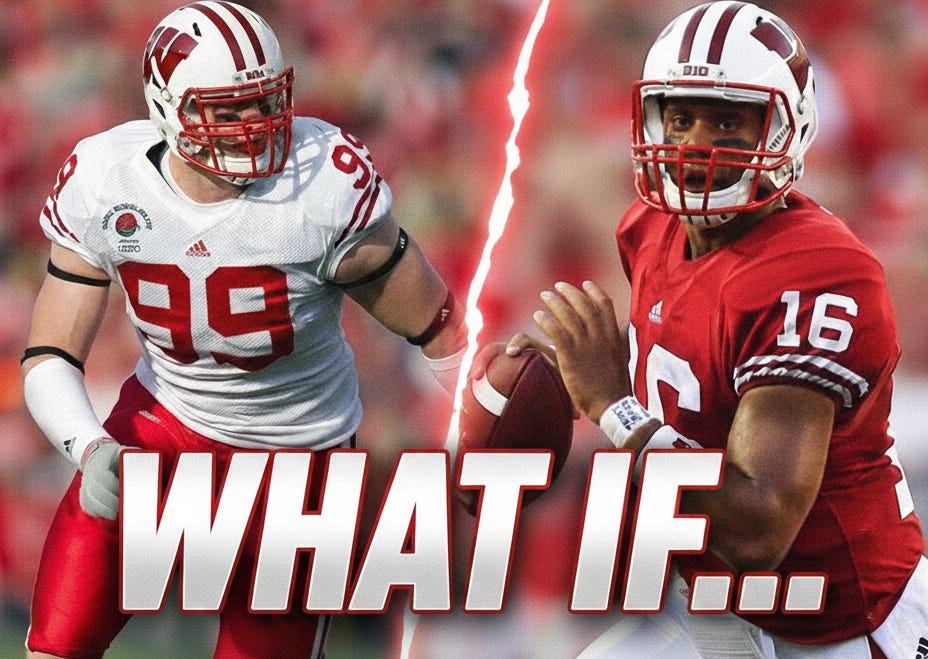
Introducing the “What If” Series
Every sports fan has a mental shelf dedicated to the “ones that got away,” the games, the plays, and the decisions that still keep us up at night. For Wisconsin Badger fans, that shelf is especially crowded. We’ve spent decades perfecting the art of the “almost,” watching legendary teams come within a whistle, a bounce, or a single player’s decision of immortality.
In this new series, we’re cracking open those sliding door moments to imagine a different reality. We aren’t just looking at the box scores; we’re analyzing the ripple effects on recruiting, coaching legacies, and the very identity of the program.
To kick things off, we start with the ultimate intersection of power and timing: What if the most dominant defensive force of a generation had stayed to join the most efficient offense in Big Ten history?
What if J.J. Watt stayed for the 2011 season and played with Russell Wilson?
This “What If” is among the most popular of Badger debates because it brings together the two most dominant individual forces in Wisconsin football history: Russell Wilson and J.J. Watt.
In 2011, Russell Wilson led the most efficient offense in the country. In the NFL, J.J. Watt was about to become the most dominant defender of a generation. If their timelines had overlapped for just one more season, the trophy case in Madison would look very different.
🏈 The 2011 “Super Team”
In 2011, J.J. Watt was a rookie with the Texans. In this alternate universe, he returns for his senior year to lead a defense that was already ranked in the top 20 nationally in points allowed (19.0 PPG).
The “Watt Factor” in the Losses Wisconsin finished 11-3 in 2011, but they were literally two plays away from an undefeated regular season. Both losses came on final drives where the opposing QB had too much time to throw:
The “Rocket” at Michigan State: Kirk Cousins had enough time to reset his feet and heave a 44-yard prayer. With Watt’s 2011 “NFL-ready” pass rush, Cousins likely never gets that pass off cleanly. He’s either sacked or forced into a hurried checkdown before the play can even develop.
The Braxton Miller Scramble at Ohio State: Miller escaped the pocket and found Devin Smith for a 40-yard TD with 20 seconds left. Watt’s closing speed and 21.0 TFL-caliber disruption would have bottled up Miller far more effectively than the standard UW rush.
The Verdict: Wisconsin would probably not be in a position to lose via Hail Mary to either Michigan State or Ohio State, but even if they are, Watt would likely play a factor in the outcome of the play, benefitting the Badgers. Wisconsin likely wins both games, entering the postseason 13-0 as the Big Ten Champions.
🏆 The Alternate National Championship: Wisconsin vs. LSU
In 2011, the BCS gave us a “boring” rematch between Alabama and LSU. In our world, the undefeated Badgers take the #1 or #2 spot for a date in New Orleans.
The Unstoppable Force: Wisconsin’s Offense Led by Russell Wilson and Montee Ball, this unit didn’t just move the ball; they broke the scoreboard.
Offensive Efficiency (OFEI): 1.97 (Ranked #1 in the nation).
The Statistical Reality: This remains the most efficient offense in the history of the FEI ratings (2007–Present). They were nearly a full two standard deviations better than the average FBS team.
The Firepower: 44.1 points per game and a staggering 7.0 yards per play.
The Immovable Object: LSU’s Defense Anchored by Tyrann Mathieu and Morris Claiborne, the Tigers’ secondary was a “No Fly Zone” before the term was even popular.
Defensive Efficiency (DFEI): 0.95 (Ranked #2 in the nation).
The Statistical Reality: They allowed only 0.5 passing touchdowns per game and held opponents to a measly 2.7 yards per rush.
The Firepower: LSU’s defense was so dominant they outscored several of their own opponents’ offenses during the 2011 regular season.
The “Alternate Title Game” Recap
The Struggle: LSU’s defense keeps it close early. But LSU’s offense was its Achilles’ heel—they had zero passing game (Jordan Jefferson finished the real title game with only 53 yards).
The Watt Effect: J.J. Watt is a problem for LSU’s O-line, effectively minimizing their run game and forcing Jefferson into multiple turnovers.
The Dagger: Russell Wilson manages the game perfectly, finding Nick Toon and Jared Abbrederis for key scores. Montee Ball (who had 39 TDs that year) grinds out the clock in the 4th quarter.
Final Score: Wisconsin 24, LSU 10
🚀 The “Sliding Doors” Consequences
Winning the 2011 National Championship doesn’t just change that year; it rewrites the next decade for the Badgers:
Bielema Stays: Bret Bielema likely never leaves for Arkansas in 2012. You don’t leave a program that has just won a National Championship.
The Recruiting Boom: Wisconsin becomes the destination for every elite O-lineman and RB in the country. They stop being “the team that almost wins” and start being a perennial contender out of the Big Ten.
J.J. Watt’s Legacy: Instead of being the “NFL Great who never won a title,” he is the Wisconsin legend who delivered the first-ever National Championship to Madison.
The Bottom Line: J.J. Watt admitted his decision to leave was “much closer than people think.” If the pros and cons had tipped the other way, Wisconsin wouldn’t just be a “consistent Big Ten program”—they would be a National Champion.
It means a lot to have you here at The Badger Backer. I’m passionate about digging deep into Wisconsin football and basketball, and your readership makes it all worthwhile. Catch up on previous posts or ensure you don’t miss anything by subscribing below! Let’s keep the Badger conversation going!
Follow me on ‘X’ @christianborman and @thebadgerbacker!
The Badger Backer is a reader-supported publication. To receive new posts and support my work, consider becoming a free or paid subscriber.